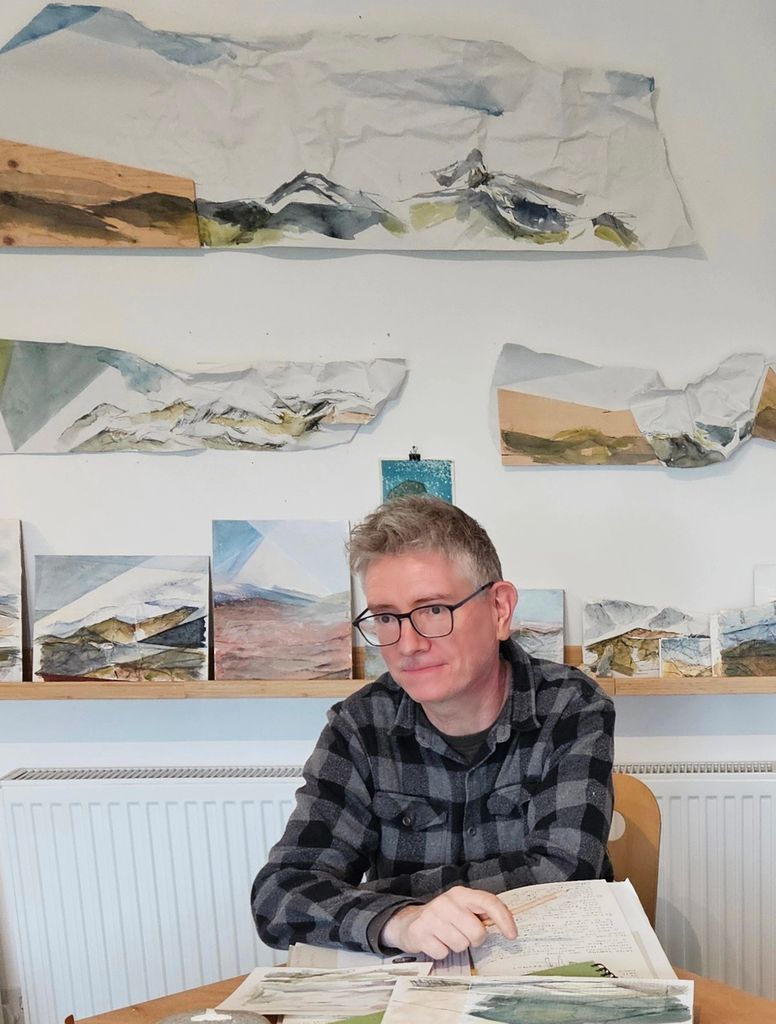
Clive Brandon
I am a visual artist based on the Black Isle in the Scottish Highlands, working primarily with landscape painting and collage.
I graduated in Fine Art and Art History from De Montfort University in 1996 and moved to Zurich, where I established a studio and exhibited in Switzerland. In 2000, I returned to London where I continued my practice alongside working at Tate Gallery. I was represented by Galerie Hubert Baechler between 2001 and 2012, with solo exhibitions in 2001, 2004, 2007 and 2011. I completed an AHRC-funded, part-time MA in Fine Art at Wimbledon College of Art (2006–08), followed by exhibitions in London and Berlin, including Transition Gallery and APT Gallery.
In 2013–14 I spent eighteen months travelling through the UK and Scandinavia, undertaking artist residencies and volunteering on organic smallholdings, where I learned about Permaculture and sustainable living. The resulting work, Travelogue/Northern European Residencies 2013–14, was exhibited at The Briggait, Glasgow, in 2015.
I moved to the Black Isle in 2015 and, with my partner Julie, developed a Permaculture-inspired smallholding. In 2025, after several years establishing it, I returned to focus on my art practice through the Creative Practice 4 module at Moray School of Art. I now see myself as a re-emerging artist with renewed energy and focus. Recent exhibitions include Awkward Objects at Circus Artspace, Inverness (2025), Strata at WASPS Inverness Creative Academy (2026), and Terrain at Auto Amor HQ, Sevenoaks (2026).
Artist statement
I make paintings, collages and mixed-media works, alongside photography, books and interventions, inspired by the landscapes around me: not as untouched wilderness, but as places shaped by people, time and nature.
My work explores how landscapes are altered through human intervention, extraction and ecological change. In the Scottish Highlands, environments often perceived as wild have been profoundly shaped by centuries of human management. I think of these as constructed landscapes, and I am interested in the structures and patterns that connect the natural and the built, and in the traces humanity leaves even in the seemingly most natural places. Ruination, degradation and the failure of modernism's utopian promise run through the work.
The work is constructed in the same way. I combine found imagery, observational drawings and remembered places with watercolour, acrylic, charcoal, pencil, newsprint and materials such as torn paper, cardboard, scrap wood and tape. Through layering, cutting, assembling and reworking, I build images in which recognisable landscapes are fragmented, altered and reimagined, to be read like a map or a book, following clues of topography and pattern. Collage mirrors how the landscapes themselves are made: parcelled into patchworks of field and forest, cleared and reworked to suit human purposes, often at the cost of the land itself.
I embrace the imperfections of the materials and the provisional nature of collage, allowing the work to develop through experimentation and improvisation rather than a fixed plan. In many works I leave open space within and between the elements, giving the viewer room to pause, as on a walk. This connects with the Japanese aesthetic of wabi-sabi, which values imperfection and impermanence, and with the cheap, everyday materials of Casualist art.
Living on the Black Isle has brought a close, sustained relationship with the landscape. The seasons and the effects of human activity around me, alongside the wider Highland mountains, forests and coasts, continue to feed into the work. As a regenerative gardener working with Permaculture, I observe the same patterns and cycles of weather, growth and change in the garden as in the studio, with the climate and ecological crisis as the backdrop to both.
My approach draws on modernist abstraction and historical traditions of landscape art, from the Picturesque and sublime to Land Art and Minimalism, with architecture, maps, books and found imagery long informing my practice. Influences include Robert Smithson, Gordon Matta-Clark's Anarchitecture, Paul Nash, and the 1950s work of Joan Eardley and Francis Davison.